
Hey. It’s been a while.
If you’ve followed this blog for any length of time, you know I don’t post for the sake of posting. The last several months have been genuinely heads-down in a way that didn’t leave much room for reflection, let alone writing. We’ve been navigating a significant AI transition across our organization, and at the same time I’ve been wrestling with a question I couldn’t shake:
What does it mean to be an Agile coach in an organization that’s actively adopting AI?
I didn’t have a clean answer. I still don’t, fully. But I’ve learned enough to think out loud about it, so here we go.
The question I kept getting asked
Sometime in the last year, a version of the same conversation started happening everywhere. With coaches on my team. With engineering leads. With product folks. Sometimes with the person staring back at me in the mirror.
Does AI make coaching obsolete?
My gut reaction was no, obviously not, the human stuff still matters. But that’s a lazy answer, and I’ve spent enough time calling out lazy answers in retrospectives that I owed it to myself to do better.
So I sat with it. And I think the real answer is: AI doesn’t make coaching obsolete. It makes shallow coaching obsolete. And that’s actually a gift, if you’re willing to receive it that way.
What shallow coaching looks like
I want to be careful here because I’m not throwing anyone under the bus, including past versions of myself.
Shallow coaching is when the value you provide is primarily procedural. You run the ceremonies. You protect the team from interruptions. You remind people what the Definition of Done says. You ask “what are your impediments” every morning and help route them somewhere.
That work is real. It mattered a lot in organizations that had never seen Agile before. But here’s the uncomfortable truth: a well-designed AI tool can do a meaningful portion of it. Not all of it. Not the nuanced stuff. But enough of the scaffolding that if scaffolding is all you’re providing, you’re in a vulnerable position.
What AI actually changed for me
Here’s where it gets interesting, and where my experience this past year has genuinely shifted how I think about the craft.
I started building. Not because someone asked me to, but because I had a problem I needed to solve. My team was spending a disproportionate amount of time on work that was valuable but not high-leverage. Documentation quality checks. Story formatting. Surfacing buried context in old tickets. Generating summaries for stakeholders who needed the “so what” without the “everything else.”
I started automating those things. Not to replace coaching, but to protect it. The goal was to free up the human hours for the work that actually requires a human: navigating conflict, building psychological safety, helping a leader see their own blind spots, sitting with a team through a hard retrospective and knowing when to push and when to just hold the space.
What I discovered in the process was that building the tooling forced me to think more rigorously about what coaching actually is. You can’t automate something until you can define it. And defining it clearly, breaking it into its component parts, asking which parts require judgment and which parts require consistency… that process made me a better coach.
The concept that reframed everything for me
I’ve started thinking about coaching less as a service I deliver and more as a product I build and maintain.
When you’re a service, you show up when called. You’re reactive by nature. Your capacity is your constraint.
When you’re a product, you design for scale. You think about the user experience for every person your function touches, including the ones you don’t have direct contact with. You build systems that deliver value even when you’re not in the room. You measure outcomes. You iterate.
That mental shift changed how I approach almost everything. It changed how I think about the team I lead. It changed what I put on my roadmap. It changed how I talk to executive leadership about what the coaching function is actually doing for the organization.
AI made that shift possible in a practical sense, but the shift itself is a human one. It’s a choice about what kind of professional you want to be.
What this doesn’t mean
I want to be clear about something, because I’ve seen this go sideways.
Coaching-as-a-product doesn’t mean turning your coaching function into a ticket queue. It doesn’t mean hiding behind tooling to avoid the hard conversations. It doesn’t mean optimizing your way out of presence.
The coaches I most respect are the ones who are deeply, uncomfortably present with the people they work with. Who sit in the tension instead of diffusing it. Who tell leaders things they don’t want to hear and do it with enough skill that the leader actually hears it.
AI can surface the data that makes that conversation possible. It cannot have the conversation.
Where I think this is going
Coaches who will thrive in the next five years are going to need to be fluent in three things they may not have had to prioritize before.
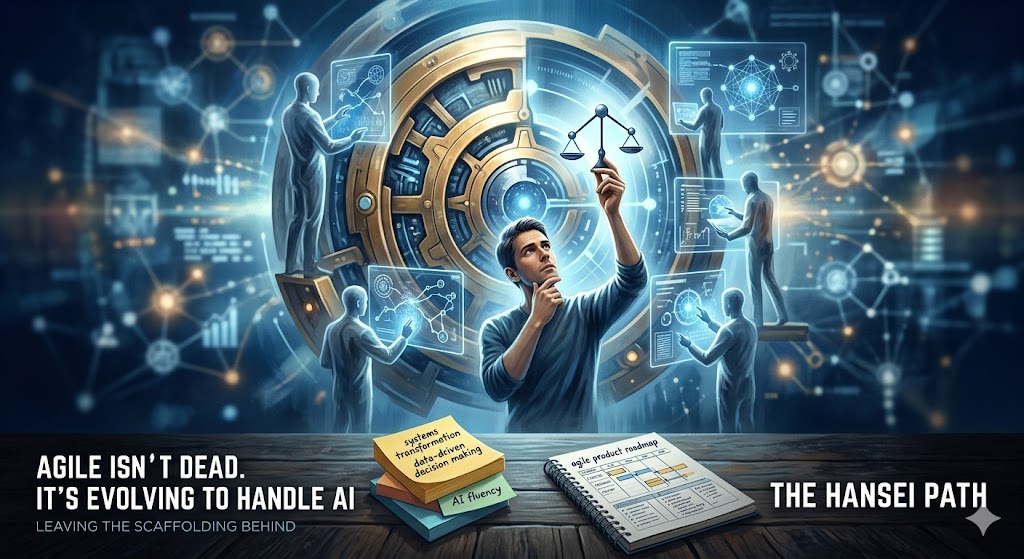
Systems thinking. Not just team-level dynamics, but how the coaching function connects to organizational strategy, how interventions ripple across departments, how you design for second-order effects.
Data literacy. Not becoming a data scientist, but being comfortable reading metrics, asking the right questions of your tooling, and translating signals into coaching decisions.
AI fluency. Not just using AI tools but understanding what they’re good at, where they fail, and how to design human-AI workflows that make the human better rather than more dependent.
None of this replaces empathy, presence, or the ability to build trust in a room. But those things alone aren’t enough anymore either.
Coming up
I have a lot more to say about each of these areas, and I’ll be posting more regularly again as I surface things worth sharing. In the meantime, if any of this resonates, or if you’re wrestling with the same questions in your own practice, I’d genuinely love to hear what you’re seeing.
It’s good to be back.

